Category: GAMES

  • Was CJ Real? The Real Los Angeles Behind GTA San Andreas

    Was CJ Real? The Real Los Angeles Behind GTA San Andreas

    An evidence-based look at the real events, gangs, and people behind GTA San Andreas – and where Rockstar reshaped the facts.

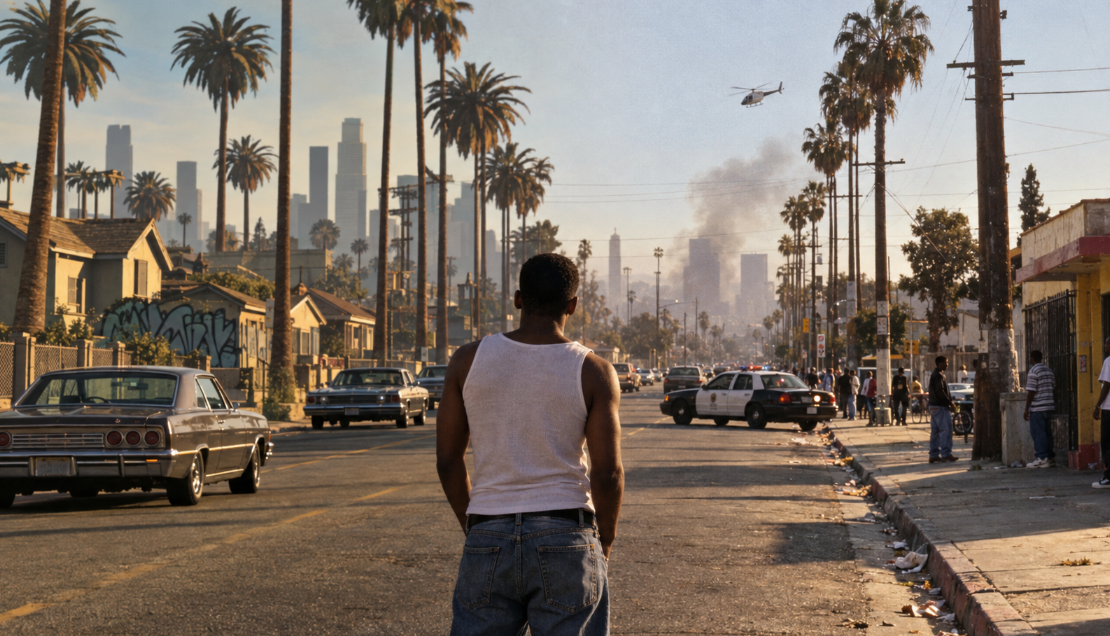
    In short. CJ was not based on a single real person. Rapper Young Maylay provided the character’s voice and appearance, but his life story does not match Carl Johnson’s fictional biography . At the same time, nearly every major element of San Andreas – gang warfare, crack cocaine, corrupt police officers, and the riots at the end of the game – can be traced back to documented events in Los Angeles during the late 1980s and early 1990s.

    Below are six real-world cases from that era and how Rockstar transformed them into the world of San Andreas.

    The Real Question Behind CJ

    There are hundreds of videos online claiming to reveal the “real CJ”: invented names, cosplay, fabricated biographies, and AI-generated “facts.” Most of them answer the wrong question.

    The only real person directly connected to CJ is Los Angeles rapper Young Maylay, who voiced the character and served as the basis for his appearance. However, even sources discussing this connection make it clear that Maylay’s life and Carl Johnson’s story followed very different paths.

    The more useful question is not whether CJ himself existed, but whether the world around him was real.

    And this is where San Andreas becomes surprisingly grounded. It is not simply a fantasy version of criminal Los Angeles. It is a collage built from real events, places, institutions, and cultural conflicts that can be traced through historical sources.

    1. Geography: Los Santos Is Los Angeles

    The most obvious layer establishes the basic rule Rockstar follows throughout the game.

    Los Santos represents Los Angeles, San Fierro represents San Francisco, and Las Venturas represents Las Vegas. The Gant Bridge is modeled after the Golden Gate Bridge.

    The similarities are never completely literal. Rockstar takes recognizable architecture, neighborhoods, road layouts, and landmarks and reshapes them to fit a fictional world.

    This principle – take something real and move it one step sideways – applies to almost every other part of San Andreas as well.

    2. Gangs: Grove Street and Ballas Echo Crips and Bloods

    The real case. The Crips emerged in South Los Angeles around 1969–1971. Teenagers Raymond Washington and Stanley “Tookie” Williams helped unite youth groups from the eastern and western parts of the area.

    As the Crips expanded, rival groups in Compton and nearby neighborhoods, especially those associated with Piru Street, formed alliances in opposition. These groups became known collectively as the Bloods.

    The conflict between Crips and Bloods went on to shape the criminal geography of Los Angeles for decades. Washington was killed in a drive-by shooting in 1979, while Williams was executed in 2005.

    How the game uses it. The central conflict in San Andreas revolves around the war between Grove Street Families and the Ballas. Their rivalry clearly draws on the long-running conflict between Crips and Bloods.

    Where Rockstar changed reality. The colors are deliberately different.

    In real life, Crips are strongly associated with blue, while Bloods are associated with red. In the game, Grove Street wears green and Ballas wear purple.

    Rockstar borrowed the structure of Los Angeles gang culture without making either group a direct copy. It is one of the clearest examples of the studio’s method: recognizable reality, but altered enough to become its own fictional system.

    3. Crack Cocaine: The Economy Grove Street Is Fighting Against

    The real case. One of the most famous figures associated with the Los Angeles crack epidemic is Ricky Donnell “Freeway Rick” Ross.

    During the 1980s, Ross built a massive crack distribution network in South Central Los Angeles. Prosecutors later estimated that his organization handled hundreds of millions of dollars in sales.

    A key figure in his supply chain was Danilo Blandón, who had connections to fundraising for the Nicaraguan Contras. That relationship gave Ross access to cocaine at prices that allowed him to undercut competitors across the city.

    Ross’s case later became central to journalist Gary Webb’s 1996 San Jose Mercury News investigation into links between Contra-connected cocaine traffickers and the American crack trade.

    In 1996, Ross received a life sentence, which was later reduced.

    How the game uses it. Crack is not simply background detail in San Andreas. It is one of the main engines of the plot.

    Los Santos is shown as a city destabilized by the drug trade, while Grove Street Families initially present themselves as strongly opposed to hard drugs entering their territory.

    The decline of the gang and the betrayal within it are closely tied to the question of who is willing to profit from crack and who is not.

    Rockstar turns the drug economy of the period into a central narrative conflict rather than using it merely as atmosphere.

    4. Corrupt Cops: C.R.A.S.H. and Officer Tenpenny

    The real case. The clearest real-world parallel for the corrupt police officers in San Andreas is the scandal involving the LAPD’s C.R.A.S.H. unit, short for Community Resources Against Street Hoodlums.

    The most notorious part of the scandal centered on the Rampart Division.

    Official investigations between 1998 and 2000, triggered in large part by testimony from officer Rafael Pérez, eventually implicated more than 70 police officers. Allegations included beatings, planting evidence, shooting unarmed suspects, and dealing in confiscated cocaine.

    Pérez himself was arrested for stealing approximately eight pounds of cocaine, worth more than $1 million, from an LAPD evidence facility.

    According to his testimony, members of C.R.A.S.H. had effectively begun behaving like a gang themselves.

    The consequences were enormous. More than 100 criminal convictions were overturned, C.R.A.S.H. units were disbanded by 2000, and the city paid millions of dollars in settlements connected to wrongful convictions and police misconduct.

    Another important connection. One of the events that helped expose the wider scandal was the death of LAPD officer Kevin Gaines. Investigators discovered that Gaines had links to Death Row Records and its co-founder Suge Knight.

    That connection brings together two worlds that San Andreas also repeatedly overlaps: corrupt policing and the West Coast rap industry.

    How the game uses it. Officer Frank Tenpenny and his partners belong to a unit called C.R.A.S.H., using the same acronym.

    The idea of police officers who plant evidence, manipulate gang conflicts, intimidate witnesses, and use CJ as a disposable tool is clearly shaped by the real Rampart scandal.

    Rockstar did not simply borrow the name. It transformed a major LAPD corruption case into one of the game’s central antagonistic forces.

    5. The 1992 Los Angeles Riots: The Real Disaster Behind the Finale

    The real case. On March 3, 1991, Los Angeles police officers brutally beat Black motorist Rodney King after a high-speed pursuit. A nearby resident recorded the beating on video, and the footage was broadcast across the United States.

    On April 29, 1992, a jury acquitted four white officers charged in connection with the beating.

    Within hours, Los Angeles erupted.

    The unrest lasted for five days. More than 50 people were killed, over 2,000 were injured, and more than 1,000 buildings were damaged or destroyed. Property losses exceeded $1 billion.

    Around 9,800 members of the California National Guard were deployed, and nearly 12,000 people were arrested.

    How the game uses it. The final section of San Andreas, when Los Santos descends into riots, burning buildings, looting, and street violence, is an unmistakable reference to the 1992 Los Angeles unrest.

    The game places CJ inside a fictionalized version of a real historical catastrophe.

    Instead of merely referencing the riots in dialogue or background details, Rockstar uses them as the emotional and visual climax of the story.

    6. Music: The Sound of the Era Became the Soundtrack

    The real case and its reflection in the game. The musical identity of San Andreas is built around West Coast hip-hop and G-funk from the late 1980s and early 1990s.

    The soundtrack includes artists such as N.W.A., Dr. Dre, Ice Cube, Ice-T, and musicians associated with the Death Row Records era.

    The fictional rapper Madd Dogg is often interpreted as a composite character built from several real artists. Ice-T voices him, while aspects of his image and career have been linked to Dr. Dre, Ice Cube, and other major West Coast figures.

    Even the name “Dogg” naturally evokes artists such as Snoop Dogg and Nate Dogg.

    His storyline – fame, collapse, addiction, depression, and a comeback – compresses several familiar themes from the lives of artists connected to that scene.

    And once again, the Kevin Gaines connection to Death Row Records shows how closely street culture, policing, and the rap industry could overlap in real Los Angeles.

    Those same three worlds constantly intersect throughout CJ’s story.

    So, Was CJ Real?

    CJ himself was not a real historical person.

    The search for a “real Carl Johnson” ultimately leads back to Young Maylay, the rapper who gave the character his voice and helped shape his appearance [1]. But Maylay’s biography is not the story of CJ.

    The better question is whether CJ’s world was real.

    And here the answer is much clearer.

    The rise of Crips and Bloods, the crack economy associated with figures such as Freeway Rick Ross, the LAPD Rampart scandal, the C.R.A.S.H. unit, the 1992 Los Angeles riots, and the rise of Death Row-era G-funk are all part of the documented history of the city.

    San Andreas did not invent Los Santos from nothing.

    It rebuilt Los Angeles through fictional names, altered gang colors, compressed timelines, and an invented protagonist at the center of it all.

    That is one reason the game continues to feel unusually convincing decades later. Beneath the satire and exaggeration is a world assembled from real history – one that can still be traced back to the sources.
  • San Andreas Definitive Edition vs. the Original: Is It Worth It?

    San Andreas Definitive Edition vs. the Original: Is It Worth It?

    Short answer. If you simply want to play through San Andreas on modern hardware, with modern controls and 4K support, the Definitive Edition is finally in a good enough state after the 2024 patches — and it is worth picking up on sale. If what you care about is that Los Santos from 2004 — the orange skies, the haze on the horizon, the sense that the world stretches on forever — the original game with a few mods is still the more authentic choice. Here is why, and which version makes the most sense for different players.


    What Actually Happened in 2021

    The Definitive Edition launched on November 11, 2021 as part of the remastered GTA trilogy. It was developed by Grove Street Games in Unreal Engine 4 rather than the original engine and, more importantly, was built to a large extent on top of the later mobile version of the game.

    That decision brought a long list of problems with it: bugs, strangely plastic-looking cars and character models, misspelled signs caused by AI-upscaled textures, and bizarre weather effects.

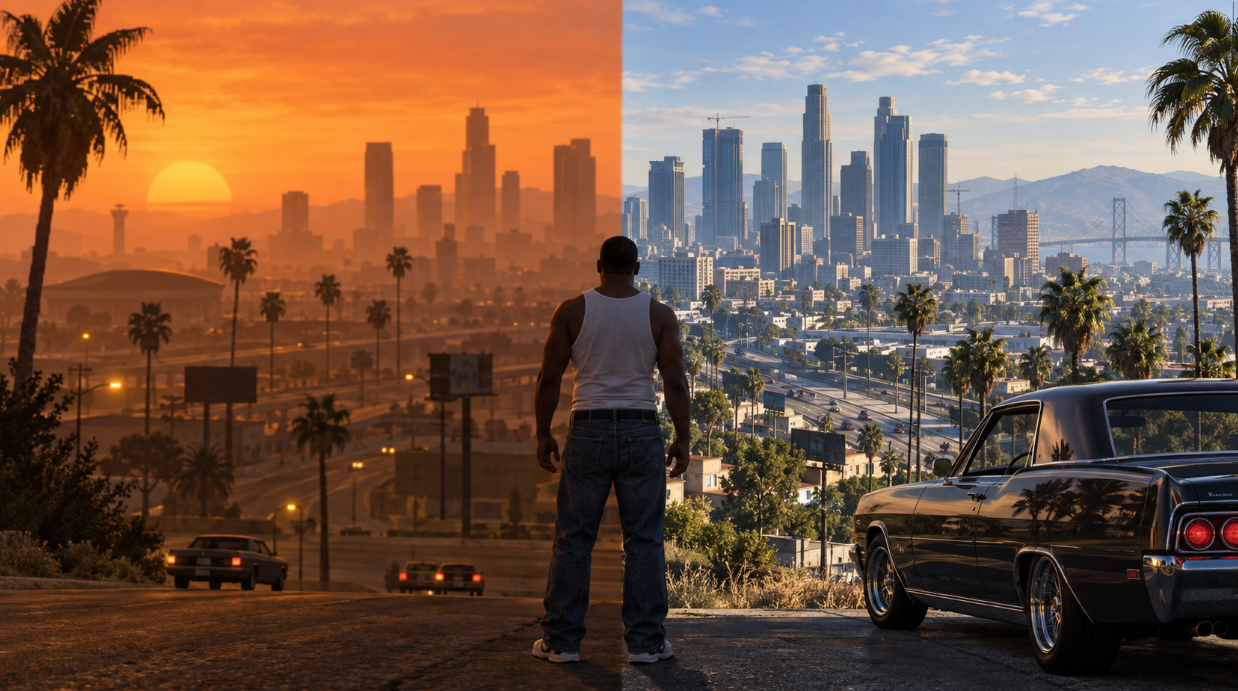
    But the biggest complaint was never really about the bugs — bugs can be fixed over time. The real problem was that the game had stopped feeling like itself. Rockstar stripped away much of the original warm lighting and replaced it with a cleaner, brighter look. Los Santos went from a sun-scorched, crime-ridden take on early-’90s Los Angeles to something that often felt like a sterile set.

    Almost everyone noticed the difference. Far fewer people could explain exactly why it felt so wrong.

    What the Definitive Edition Genuinely Does Better

    To be fair, the remaster is not just a collection of compromises. Some of its changes were long overdue.

    • Controls and shooting. The control scheme is closer to GTA V, aiming feels better, and you can move more naturally while shooting. Compared with the clunky combat of the 2004 release, it is a major improvement.
    • Weapon and radio wheels. You no longer have to cycle through your entire arsenal in the middle of a firefight or scroll through every radio station just to get back to the one you want.
    • Checkpoints. Fail a long mission and you no longer have to drive halfway across the map just to start it again. That alone saves hours over the course of a playthrough.
    • Graphics, at least on paper. 4K resolution, higher-resolution shadows, vehicle reflections, and vastly increased draw distance without objects constantly appearing right in front of you.

    If you judge San Andreas purely as a product expected to meet modern standards, the unmodified original is badly dated in all of these areas.

    What Was Lost — and Why It Matters More Than You Might Think

    This is where simple before-and-after videos can be misleading. They show you that the image is sharper. What they do not show is that the game feels different.

    The Fog That Disappeared

    In the original San Andreas, there was almost always haze hanging over the horizon. Technically, it was a limitation of the PlayStation 2. With just 32 MB of memory, the console simply could not render the entire state at once, so fog was used to hide what the engine had not loaded yet.

    But something interesting happened: that technical limitation became an artistic tool.

    The fog created a sense of scale. You could not see where the map ended, so the world felt enormous. It also gave individual regions their atmosphere: the morning haze around San Fierro, the heat shimmering over the desert, the distant skyline fading into the air.

    At launch, the Definitive Edition removed most of that fog. Draw distance was pushed dramatically farther out, letting you see almost everything.

    And suddenly the huge world felt smaller. When you can stand on a hill and see across a massive portion of the map, the illusion of distance disappears. Technically, the game became more impressive. Atmospherically, something fundamental was lost.

    It is a perfect example of how removing a limitation can also remove the thing that limitation accidentally helped create.

    The Orange Los Santos

    That famous warm, yellow-orange glow over Los Santos was not an accident, nor was it simply a consequence of “old graphics.” It was part of the game’s visual identity — its own stylized version of early-’90s Los Angeles.

    The remaster replaced much of it with brighter, more neutral lighting, and the West Coast setting lost some of its personality.

    GTA III suffered from the same problem. Its murky grey look was a big part of what made Liberty City feel heavy, bleak and almost noir-like. Strip that away and the city immediately feels less distinctive.

    The Small Things That Add Up

    1. Crosshair health feedback. In the original, the crosshair changed colour to reflect how much health an enemy had left — a surprisingly forward-thinking feature for its time. The Definitive Edition replaced it with a much simpler white crosshair.
    2. Music. Some licensed songs are missing from the soundtrack. To be fair, several of them had already disappeared from earlier re-releases and were not removed specifically for the Definitive Edition.
    3. Some cheat codes no longer work.
    4. Two-player local multiplayer from the PS2 version is completely absent.

    Taken individually, these may sound like minor complaints. Together, they are the sort of thousand tiny cuts that gradually erode the feeling of playing the San Andreas people remember.

    The Patch That Changed the Conversation: November 2024

    There is an important twist here, and leaving it out would make any comparison unfair.

    Almost exactly three years after launch, on November 12–13, 2024, a major update — version 1.112 — arrived for PC, PS5 and Xbox Series consoles, followed by other platforms.

    The headline feature was Classic Lighting, which Rockstar said was designed to restore the look and feel of the skies from the original games.

    And this time, it was not just marketing language.

    The warmer lighting returned. Street lamps once again had an orange glow rather than harsh white light. Volumetric clouds, lens effects, heat haze and more dynamic shadows helped bring back much of the atmosphere that had been missing.

    GTA III and Vice City also received gameplay and animation fixes.

    One particularly telling detail was that Grove Street Games was removed from the opening credits. By that point, much of the work had effectively been taken over by the team behind the mobile version, Video Games Deluxe — the same version that had already received a warmer reception.

    The result is that the Definitive Edition you can play today is not the same game that failed so spectacularly in 2021.

    It is far more stable, and with Classic Lighting enabled, a significant amount of the original atmosphere has finally returned.

    But not all of it.

    It is still an approximation of the original rather than the original itself.

    Definitive Edition vs. a Modded Original

    For players who care about authenticity, the real alternative is not the untouched 2004 PC release. It is the original game with a small collection of mods.

    A lightweight setup using fixes such as SilentPatch can solve old bugs and make the game behave properly on modern systems. Add a few visual mods if you want sharper textures or improved lighting, and you can modernise the presentation without destroying the visual identity of the original.

    The choice is fairly simple:

    • A modded original gives you the most authentic version of San Andreas and complete freedom to customise it, but you have to spend some time installing and configuring everything. The original PC version is also no longer sold on Steam, so getting hold of it is less straightforward than it used to be.
    • The Definitive Edition gives you better compatibility, modern controls and quality-of-life improvements straight out of the box, but visually and atmospherically it still does not feel quite identical to the original.

    And there is one revealing point worth mentioning: even years later, the original San Andreas has continued to attract a remarkably active player base. The community never really abandoned it.

    Verdict: Which Version Should You Play?

    Buy the Definitive Edition if: you are playing San Andreas for the first time, coming back after many years, or simply want to play through the story without dealing with mods. It is also the easier option if you are on console or playing handheld. Just make sure you enable Classic Lighting in the settings. Without it, you are giving up one of the biggest improvements added since launch. And preferably, buy it on sale.

    Stick with the original — ideally with mods — if: San Andreas is not just a game you want to finish, but a place you keep coming back to. If the original lighting, fog, atmosphere and overall feel matter to you, the classic version still gets closer to what made the game special. You just need to be willing to spend some time setting it up.

    The main thing to remember is this: the word “Definitive” mostly applies to resolution, compatibility and convenience — not absolute faithfulness to the original.

    The remaster answers the question, “How do we make San Andreas easier to play today?”

    The much harder question is, “How do we modernise San Andreas without making it feel like something else?”

    And in many ways, the community has been better at answering that question than the official remaster ever was.


    What you gain and what you lose when moving to the remaster is difficult to capture in a simple before-and-after video. A video can show you the difference. Understanding what that difference actually costs is something text can explain far better.